Industry · 9/21/2026
When AI Leaves the Screen, the Test Changes
Physical AI should be judged by more than recognition accuracy. A bounded inspection pilot can test whether edge inference meets timing requirements, fails safely and improves on an existing quality-control baseline—before it gains authority over a machine.
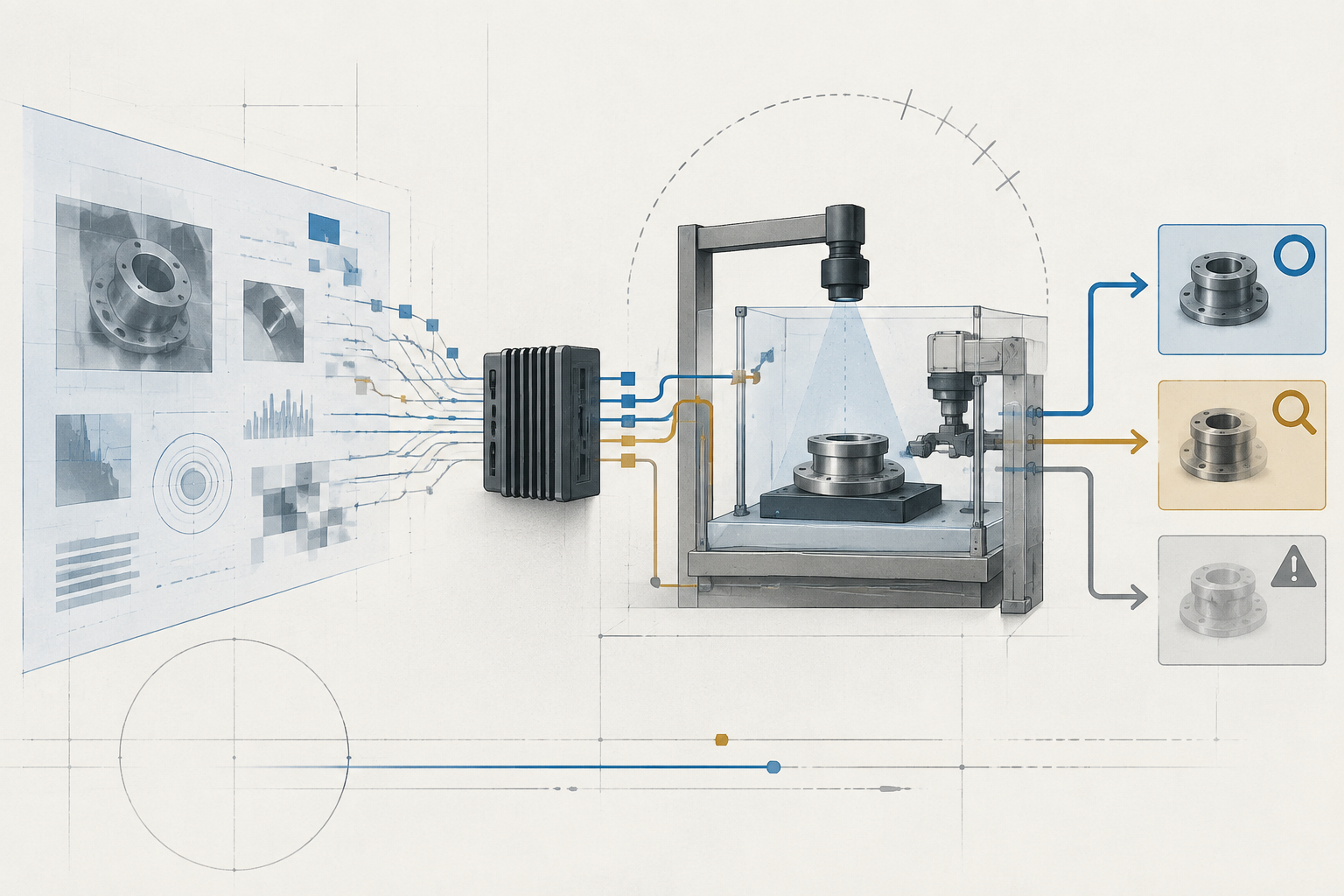
An answer on a screen invites review. An instruction to a machine demands a different question: what are we allowing to happen before anyone can review it?
Coming from steel, rail, welding, quality and learning, I would approach physical AI through that question—not through the apparent intelligence of a demonstration. My starting point would be the permitted action, its deadline and the consequence of being wrong.
Fact
Embedded Computing Design has published coverage connecting edge AI with robotics, industrial automation and physical AI [1]. New Electronics reports a NEURA Robotics–SECO partnership to advance physical AI manufacturing in Europe [2]. Unite.AI describes their partnership in terms of robot compute modules built in Europe [3].
Those are signals of engineering and commercial attention. The supplied items do not establish measured latency, inspection accuracy or safe-failure performance. I would not treat a partnership announcement as evidence that a particular production application is ready.
Observation
My engineering reading is that moving intelligence closer to a machine should also move our attention closer to the complete decision path. Where does the image originate? Which component judges it? Who authorises movement? What happens when the answer arrives late?
For a proposed inspection cell, I would distinguish three requirements.
Latency would mean the time from image capture to an actionable, correctly associated inspection result—not merely model execution time. I would include acquisition, preprocessing, inference, communication and controller acknowledgement in the measurement boundary. A fast average would not satisfy my acceptance criteria if deadline misses remained hidden.
Reliability would mean repeatable performance within a declared operating envelope. I would ask for results separated by part variant, lighting condition, shift and defect class, rather than accepting one aggregate score. The point would be to identify where permission to operate should end.
Safe failure would mean an explicit response to missing, stale, uncertain or invalid information. For this pilot, no result would never mean a good part. It would mean hold for review, using an independently approved control sequence.
Question
Can an edge-AI inspection step improve a defined quality-control task without increasing defect escapes, creating unacceptable delays or weakening existing safeguards?
That is narrower than asking whether AI can automate inspection. It is also a question a plant team could investigate without handing a model unrestricted machine authority.
Hypothesis
For one stable part family and one visible defect category, local AI inference may provide useful inspection support within the cell’s timing budget. I would expect that hypothesis to earn further testing only if performance matches the existing quality baseline and uncertain cases reliably return to human review.
Local computation would be a design choice to test, not a guarantee of speed, availability or safety.
Experiment
I would propose a pilot at one guarded inspection station, with fixed camera geometry and controlled lighting. Scope would exclude hidden defects, new part families and changes to welding or other process parameters. The model would inspect a specified visible feature; it would not certify the whole component.
First, document the existing quality-control baseline. Record its acceptance rules, defect escapes, false rejects, review time, throughput and traceability. Define how disputed classifications will be adjudicated by qualified quality personnel. The existing inspection decision should be a comparator, not automatically the ground truth.
Then run the AI in shadow mode. It would examine the same parts without influencing disposition. Preserve part identifiers, images, timestamps, model versions and both decisions. Include independently assessed conforming and defective examples, while keeping deliberately enriched test sets separate from normal-production results.
Before collecting evaluation data, agree on the sample plan, evaluation period and acceptance limits with quality, operations and safety owners. Keep evaluation examples separate from model tuning. Report uncertainty, particularly where few defect examples limit what the trial can establish.
Measure defect escapes and false rejects by defect class, alongside review workload and end-to-end timing. Count deadline misses explicitly. Compare the AI-assisted workflow with the existing workflow, rather than comparing model inference time with an inspector’s complete task.
Next, test failures deliberately under controlled conditions: disconnect the camera, interrupt connectivity, restart the edge computer, introduce stale frames and present an unfamiliar part. Each test should have a predetermined expected response and an auditable outcome.
Only after shadow-mode acceptance would I consider limited actuation: an inspection result could request a hold for review through approved controller logic. Existing release authority would remain unchanged. The AI would have no authority over guarding, emergency stops or safety interlocks. Any physical-action trial would require its own risk assessment and approval.
Learning
The review should ask where the hypothesis failed, not simply whether the demonstration worked. Did lighting create disagreements? Did review queues erase a timing benefit? Were incorrect part associations detected? Did every injected fault produce the intended response?
A result of “useful only within this narrow envelope” would be valuable learning. So would a decision not to proceed.
My view
The idea worth carrying forward is a permission envelope for AI: defined inputs, bounded actions, explicit deadlines, clear fallback and recorded evidence. Expand that envelope only when a controlled experiment supports expansion.
For me, the shift from screen AI to machine AI is a shift from judging answers to governing consequences. The first milestone should not be a machine acting independently. It should be a team able to explain why a particular action was permitted—and demonstrate what happens when permission must be withheld.
Sources
Facts in this article were gathered from these reports. The interpretation is my own.
- Edge AI for Robotics: What engineers need to know about Industrial Automation and Physical AI - Embedded Computing Design — Embedded Computing Design
- Neura Robotics, Seco Partner on Physical AI, Robot Compute and Industrial Automation - AI Insider — AI Insider
- The Rise of Physical AI: How Intelligent Machines Are Transforming the Real World - Bisinfotech — Bisinfotech
- NEURA Robotics and SECO partner to advance Physical AI manufacturing in Europe - New Electronics — New Electronics
- NEURA and SECO Partner on Robot Compute Modules Built in Europe - Unite.AI — Unite.AI
- Accelerating edge AI — for the robot’s sake - designworldonline.com — designworldonline.com